What a trading order specifies
An order tells a broker or trading venue what transaction to attempt. It identifies the instrument, direction, quantity and execution conditions. An accepted instruction is not the same as a completed trade. A fill records the quantity and price actually transacted.
This guide explains conventional securities orders and highlights why the exact broker and venue instructions still matter. Order labels alone are insufficient to establish every execution condition. Source: Investor.gov, Understanding Order Types.
Market orders
A market order seeks prompt execution against available liquidity without a trader-specified limit price. The last transaction is historical information, not a promise about the next fill. A purchase generally interacts with offers and a sale with bids. Source: Investor.gov, Types of Orders.
Hypothetical example: the best offer is 100 shares at $40.02, with another 200 shares offered at $40.05. A market purchase of 250 shares could receive 100 at $40.02 and 150 at $40.05, assuming these offers remain available. The total is $10,009.50 and the average price is $40.038 before fees. Only part of the purchase occurred at the initially displayed best offer.
This example holds the order book still to isolate the arithmetic. In an actual market, quotations can change while an instruction is transmitted or processed.
Limit orders
A buy limit sets the highest acceptable execution price; a sell limit sets the lowest. Execution can occur at a better price, but the order can remain unfilled. Source: Investor.gov, Types of Orders.
Hypothetical example: an investor submits a buy limit for 250 shares at $40.00 while the best offer is $40.02. It cannot buy at that offer. Later, assume 80 shares are matched to the order at $40.00. The purchase is $3,200 before fees, with 170 shares still outstanding if the order instructions allow the remainder to rest. An average price displayed for the 80 shares does not mean all 250 were purchased.
A chart touching $40.00 is not evidence that this particular order received a fill. Check the broker execution report for confirmed quantity and price.
Stop orders and trigger conventions
A conventional stop becomes a market order when its trigger condition is met. Buy stops are normally placed above the current market and sell stops below it. Brokers may trigger against transactions or quotations; check the applicable standard. Source: Investor.gov, Types of Orders and the stop-order bulletin.
The stop price is the activation threshold. It is not a guaranteed exit price. A buy stop can cover a short position; a sell stop can exit a long position. The instruction can also be used to enter a position, depending on the intended trade.
Worked example: a sell stop across a gap
Assume an investor owns 200 shares purchased at $50 and places a sell stop at $47. An overnight announcement is followed by a market opening below that level. Assume the broker trigger condition is met and the resulting market order fills all 200 shares at $44.50.
The gross loss is ($50 - $44.50) × 200 = $1,100. A calculation based on the stop price alone would have estimated ($50 - $47) × 200 = $600. The $500 difference illustrates the additional loss in this hypothetical gap. Fees are excluded.
Neither the price path nor the fill is a prediction. The example demonstrates why an exit instruction and a fixed monetary loss ceiling are different things.
Stop-limit orders
A stop-limit combines an activation price with a separate execution limit. After triggering, it behaves as a limit order. This can prevent an execution beyond the limit while leaving the position open. Source: Investor.gov, Stop, Stop-Limit, and Trailing Stop Orders.
Hypothetical example: replace the preceding sell stop with a sell stop-limit using a $47 trigger and a $46.50 limit. If it activates when available bids are $44.50, it cannot sell at those bids. The investor still owns the shares unless eligible liquidity later produces a fill or another action closes the position. The order has met its price constraint without meeting the objective of leaving the position.
For a short position, consider a buy stop-limit with a $52 trigger and $52.50 limit. If it triggers while available offers are $54, that purchase cannot execute against those offers.
Trailing stops
A trailing stop adjusts its trigger as the market moves favourably and holds that trigger when the market moves against the position. The trail can be expressed as an amount or percentage. A trailing stop-limit retains limit-order execution risk. Source: Investor.gov, Stop, Stop-Limit, and Trailing Stop Orders.
Hypothetical example: a $2 sell trail follows a reference price from $50 to $55, lifting its trigger from $48 to $53. A later decline to $54 leaves the trigger at $53 under these assumed rules. Triggering at $53 still does not establish the eventual fill price.
Time-in-force and quantity conditions
Order type and order duration answer different questions. Check which combinations the broker supports. Source: Investor.gov, Understanding Order Types.
| Instruction | Meaning |
|---|---|
| Day | Valid for the applicable trading day or session |
| Good-til-cancelled (GTC) | Remains active until filled, cancelled or expired under broker rules |
| Immediate-or-cancel (IOC) | Fill available quantity immediately and cancel the remainder |
| Fill-or-kill (FOK) | Execute the full quantity immediately or cancel |
| All-or-none (AON) | Requires the full quantity; does not by itself mean immediate execution |
For the earlier 250-share example, suppose only 80 shares are immediately available at the acceptable price. An IOC could fill 80 and cancel 170. An FOK would require all 250 immediately under its rules. A day limit without either condition could leave an outstanding remainder. These are deliberately simplified comparisons, not a statement that every venue offers all combinations.
Slippage, gaps and partial fills
Slippage measures the difference between a chosen reference price and the actual execution price. State the reference when evaluating a trade: a quotation at submission and the stop trigger are different benchmarks. A gap describes a discontinuity in available prices, while a partial fill concerns quantity. These should be recorded separately.
A useful execution log records the intended quantity, order type, relevant trigger or limit, submission time, actual fills, remaining quantity and fees. For an order with several fills, calculate the quantity-weighted average rather than taking a simple average of the prices.
Differences across instruments and venues
CME describes market-with-protection and market-limit variants, as well as stop variants. Protection ranges and treatment of the unfilled remainder mean a futures instruction should not be inferred solely from a stock-market definition. Consult the relevant contract and platform documentation. Source: CME Group, Futures Order Types.
For a stock, futures contract, retail FX product or cryptoasset venue, verify the same operational questions before relying on a label:
- Which price activates a conditional order?
- Which sessions accept and activate it?
- Is the instruction held by the venue, broker or trading software?
- What happens to the remainder after a partial fill?
- Are there price protection bands or quantity restrictions?
- When does the instruction expire?
These questions identify the documentation needed; this guide does not claim a single rule applies to every FX or crypto platform.
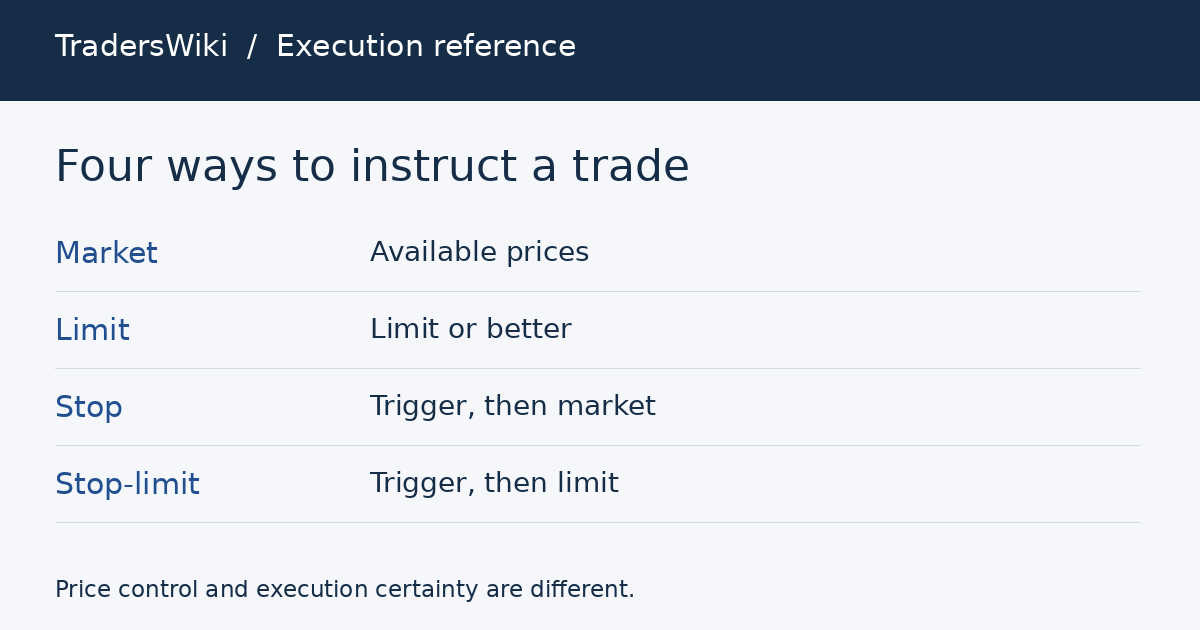
Comparison of the main instructions
| Instruction | Activation | Execution-price constraint | Principal remaining risk |
|---|---|---|---|
| Market | When accepted for execution | No trader-set limit | Execution away from the reference price |
| Limit | When accepted; waits for eligible liquidity | Buy at limit or lower; sell at limit or higher | Some or all quantity remains unfilled |
| Stop | After the specified trigger | No limit after conventional market conversion | Gap or adverse execution after activation |
| Stop-limit | After the specified trigger | Limit or better | Trigger occurs but execution does not |
This comparison assumes conventional instructions. Availability, acceptance and venue-specific safeguards still apply. Sources: Investor.gov order bulletins and CME Group.
Common order-entry mistakes
- Confusing a stop trigger with an execution limit.
- Entering the wrong side, quantity, contract month or account.
- Assuming a partially filled order is complete.
- Leaving the remaining quantity active after the trade plan changes.
- Treating a cancellation request as a confirmed cancellation.
- Ignoring session restrictions and expiry conditions.
- Reusing assumptions from another broker without checking the instructions.
Review the order confirmation and subsequent execution report. The selected instruction should reflect what matters for the intended transaction: speed, price control, conditional activation or quantity constraints. No single instruction removes all of these trade-offs.
Sources & method
- Investor.gov: Types of Orders
- Investor.gov: Understanding Order Types
- Investor.gov: Stop, Stop-Limit, and Trailing Stop Orders
- CME Group: Futures Order Types
Sources support the referenced concepts. Numerical examples are hypothetical unless stated otherwise. A link does not imply endorsement.